Service
Sub-Zero sealed-system repair
Sealed-system diagnosis and repair — refrigerant leaks, compressor faults, restrictions and evaporator failures, and an honest answer about whether to do it.
Symptoms we hear most
- Both compartments drifting warm together over a period of weeks
- The compressor running continuously and never cycling off
- Partial cooling that gets worse on hot days and recovers overnight
- Frost on only one section of the evaporator rather than across it
- A unit that was recharged elsewhere and has slowly warmed again
- Unusual heat at the grille with very little cold in the cabinet
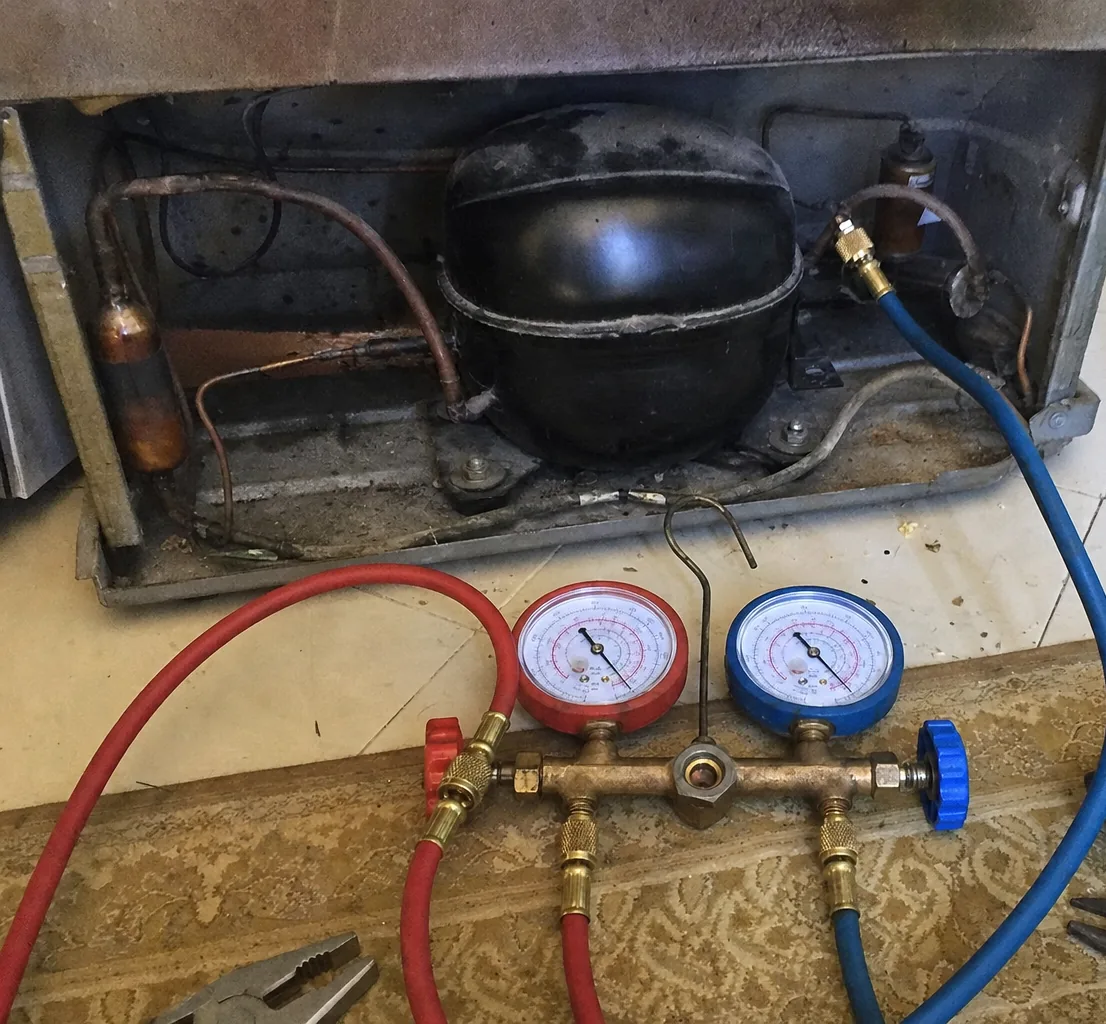
The sealed system is the closed refrigerant loop: compressor, condenser, metering device, evaporator and the tubing that joins them. It is called sealed because it is meant never to be opened, and opening it is the difference between a service call and a genuine repair. It requires recovery equipment, a proper vacuum, accurate charging by weight and EPA Section 608 certified technicians, because releasing refrigerant is not a matter of preference.
Most of the work on this page is the work of proving that a sealed-system repair is actually necessary.
Almost everything that looks like a leak is not one
A warm cabinet has a short list of causes and the sealed system is at the bottom of it, not the top. Ahead of it sit a corroded or restricted condenser, a condenser fan that has slowed or stalls once it is hot, an evaporator fan that has failed, a defrost cycle that terminates before the coil is clear, a blocked drain that has iced the trough, door seals that are letting humid kitchen air in, and a control fault that is asking for the wrong thing.
Every one of those is cheaper. Several of them are more common in Ponte Vedra Beach than anywhere inland, because the condenser here corrodes on a coastal schedule rather than a national one. A shop that reaches for refrigerant early will make a sealed-system-sized invoice out of a fin pack full of salt, and the unit will be warm again by the following summer.
So the order is fixed: eliminate air, defrost and control faults first, with readings written down, and only then treat the sealed system as the remaining explanation.
Reading the system
Once the rest is ruled out, the pattern of the failure tells you a good deal. A slow, even loss of capacity across both compartments over months suggests a leak. Frost on only the first portion of the evaporator suggests a restriction or an undercharge rather than a compressor that has stopped pumping. A unit that cools acceptably overnight and fails every hot afternoon is short of capacity margin, which can be a partial charge or a condenser that cannot reject heat. Heat at the grille with no cold in the cabinet points at a compressor running without pumping.
None of that is a diagnosis on its own. It is what shapes where we look.
Leaks get found, not topped up
Adding refrigerant to a system that lost it puts the same fault back in service with a clock on it, and every recharge introduces another opportunity for moisture to get in — which is its own failure mode, because moisture in a sealed system produces a restriction that behaves nothing like a leak. When we open a system we locate the leak, replace the filter drier, pull a proper vacuum, and charge by weight.
Coastal units have one leak location worth naming: the condenser itself. Corrosion that has gone past the fins and into the tubing does not get repaired in place, and a condenser that has failed that way on the coast usually means the rest of the loop has had the same exposure.
When the honest answer is no
Some of these repairs should not be done. A twenty-five-year-old cabinet with a failed compressor, a corroded condenser and a discontinued control board is a conversation about replacement, not a parts order, and we would rather have it before the work than after. We will not open a sealed system on a unit we do not expect to survive it, and we will tell you plainly when that is where we have landed.
When it is worth doing — and on a well-kept built-in with one clear fault, it often is — it comes with a written estimate first, the flat diagnostic credited toward the work, genuine OEM parts, 90 days on labour and 365 days on parts.
What the visit includes
- Full elimination of airflow, defrost and control faults before any cutting
- Leak location rather than a top-up that puts the same fault back in service
- Written estimate, and an honest view on whether the repair is worth doing
- Recovery and recharge by EPA Section 608 certified technicians
- 90 days on labour, 365 days on parts
From the journal
- Where to buy a Sub-Zero refrigerator, and what to check before you pay
Buy a new Sub-Zero fridge through a dealer listed on the brand's website. A used one, or one sold with a house, needs its serial tag and condition checked.
- Sub-Zero refrigerator reset button: what to press and what it tells you
A Sub-Zero refrigerator has no separate reset button: you reset it by turning it off at the panel or breaker, then on. What to check when that fails.
- Sub-Zero wine cabinet drift in a house near the water
Stability beats any single temperature, and a glass door in a Florida summer is a thin boundary. What actually threatens a cellar on this coast.
- A Sub-Zero fresh-food side warm, freezer still cold
One side warm and the other cold is a specific diagnostic clue. Here is the order faults should be eliminated in before anyone opens a sealed system.
- Salt air, condenser coils and long run times
Why a Sub-Zero within a mile of the Atlantic runs longer every year, how to read the symptom correctly, and what corrosion on the fins actually means.
What it costs
What does a Sub-Zero sealed-system repair cost in Ponte Vedra Beach?
Most of this work lands between $860 and $2,340, parts and labour together, and the visit that decides which end of that you are at is a flat $80 credited to the repair once you approve it. The firm number is written down after the diagnosis, not guessed at over the phone.
| Work | Typical range |
|---|---|
| Diagnostic visit | $80 flat, credited to the repair |
| Compressor or sealed-system repair | $860–$2,340 parts and labour |
Written estimate before anything is opened up. The invoice carries one number; a band is what can honestly be published before the cabinet is open. The full table is on the pricing page.
Customer reviews
After a sub-zero sealed-system repair visit
4.8 out of 5 from 67 customer reviews. Each one below is a single visit, described by the person who paid for it.
He told us plainly that the sealed system on a cabinet this old was still worth repairing, and why, before a single part was ordered. The work took an afternoon and the temperatures have not moved since.
Pascal L.2026-04-16
The freezer would only reach twenty degrees whatever we set it to. He tested pressures, diagnosed a restriction in the capillary, cleared the system properly with a new drier and got it back down to zero.
Nolan A.2025-07-17
Somebody else had put gas in it twice and it kept warming again. He recovered what was left, pressure tested the circuit overnight, found the loss down at the condenser end, and repaired and evacuated it properly.
Orla K.2026-04-30
Questions we get asked
Answers before you call
- What does a Sub-Zero sealed-system repair cost in Ponte Vedra Beach?
- Most of this work falls between $860 and $2,340, parts and labour together: compressor or sealed-system repair runs $860–$2,340. Which band your cabinet is in is what the diagnostic settles, and the figure on the written estimate is the one you are asked to approve.
- Is the $80 diagnostic charged on top of the repair?
- No. The $80 covers the visit and the whole diagnostic sequence, and it comes off the repair the moment you approve the work. Decide against it and the diagnostic is all you have spent: the written findings are yours to take anywhere you like. 90 days on labour, 365 days on parts, and genuine OEM parts on every repair.
- What is the most expensive part to replace on a built-in refrigerator?
- The compressor, and with it the rest of the sealed system — compressor or sealed-system repair runs $860–$2,340, parts and labour. The cost is the work rather than the part: recovery, leak location, a new drier, a vacuum and a charge by weight. Boards, fans, defrost parts and door seals all sit below it.
- When is it worth replacing the cabinet instead of repairing it?
- When the quoted repair approaches what the appliance is worth to you. A comparable built-in runs $8,600 to $19,400 for the appliance alone, before delivery, installation or panels, so a repair in the hundreds is usually the cheaper year. We say which side of that line you are on before parts are ordered, not after.
- Why not simply top the refrigerant up?
- Because a system that has lost charge lost it somewhere, and adding more puts the same fault back into service with a date on it. Recovery, leak location and repair is the longer afternoon and the only one worth paying for. Recovery and recharge are done by EPA Section 608 certified technicians.
- How do you know it is the sealed system and not something simpler?
- By eliminating the simpler things first, in order and with the readings written down. Airflow, defrost and control faults imitate a sealed-system failure closely and cost a fraction of one to put right. Nothing is cut open until those have been ruled out in front of you.
- Is a sealed-system repair worth doing on an older cabinet?
- Sometimes plainly yes and sometimes plainly no, and that is a conversation to have before parts are ordered rather than after. The written estimate sets the repair against what the cabinet is worth to you, including the condition of everything the salt air has already reached.