August 11, 2026 · ownership
Sub-Zero wine cabinet drift in a house near the water
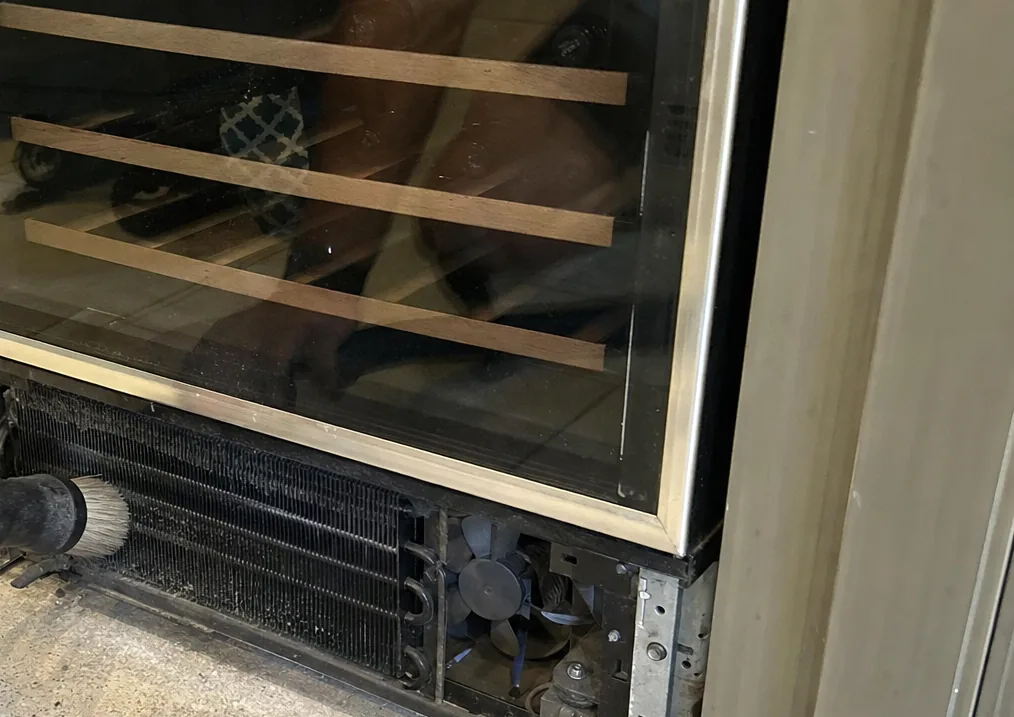
Most conversations about wine storage start with a number, and the number is usually the least important thing in the room. A cabinet sitting two degrees above its setting for a year does very little harm. The same cabinet swinging two degrees every afternoon does real, cumulative damage, and the second situation is far more common than the first — particularly in a house on this coast, where the load on the outside of that glass door changes enormously between morning and mid-afternoon.
Four things actually threaten a cellar in Ponte Vedra Beach, and temperature in the abstract is not one of them.
Swing
Wine expands and contracts with temperature. Do that slowly, once a season, and nothing much happens. Do it every day and the cork works minutely in the neck each time, which is how seepage starts and how oxygen eventually gets in.
Swing has causes you can see. A cabinet in a west-facing wall taking three hours of direct sun. A unit in a bar area or garage where the ambient itself climbs ten degrees by four in the afternoon. A condenser that has lost enough capacity that it can hold the setting in the morning and not in the afternoon. A door being opened repeatedly during a weekend of entertaining.
If your unit has started cycling noticeably more often at the same setting, it is losing margin, and losing margin is what turns a stable cellar into a swinging one. That is worth investigating before it becomes visible in the bottles.
Humidity, and why the glass matters here
Inside the cabinet you want humidity high enough to keep corks swollen. Outside it, in a Florida summer, the air is warm and close to saturated — and in a house near the marsh or the Intracoastal it stays that way for months.
The door is doing all of the work of keeping those two conditions apart. When the seal ages, you get three signs in roughly this order: condensation forming on the inside face of the glass on humid days, then a gradual drying of the racks and labels lifting at their corners, then corks that sit slightly proud.
People read those as a cooling failure and they are usually a door failure. Seals, hinges and closure adjustment are all serviceable, and they are the first thing worth ruling out before anyone talks about refrigerant.
Light
Glass doors are treated to block a good deal of ultraviolet, but treatment is not elimination, and afternoon sun in Florida is not a small dose. Light-struck wine is a genuine phenomenon and white and sparkling wines in clear or pale bottles are the most vulnerable.
This one is free to fix. If the cabinet sits where the sun reaches it, put the bottles you intend to keep longest at the back and the bottom, and consider what else in the room could be moved to interrupt the light. It is a better use of an afternoon than most upgrades.
Vibration
A compressor puts vibration into the cabinet, the cabinet into the racks, and the racks into every bottle lying on them. It is never enough to shake anything loose. It is a constant low-frequency input under a bottle you may be intending to keep for ten years, and the general view is that it is not helpful.
The practical version of this is simple: a cabinet that has developed a new hum, buzz or resonance since last year has changed. It might be a mount, a fan bearing, a panel that has loosened, or a rack that has shifted position. Those are all cheap to address early and less cheap to address once something has worn.
The one that is specific to the coast
Everything above applies to a wine cabinet anywhere. What is specific to a house within a couple of miles of the Atlantic is the condenser, because a wine unit has a much smaller temperature gap to defend than a refrigerator does. A partially corroded fin pack shows up here as more frequent cycling long before it shows up as a warm cabinet — which means, usefully, that a wine cabinet is an early-warning device for what the salt air is doing to the rest of your appliances.
If it has started cycling more, look at the condenser before you look at anything else.
What it costs
What does a Sub-Zero wine storage repair cost in Ponte Vedra Beach?
Most of this work lands between $240 and $820, parts and labour together, and the visit that decides which end of that you are at is a flat $80 credited to the repair once you approve it. The firm number is written down after the diagnosis, not guessed at over the phone.
| Work | Typical range |
|---|---|
| Diagnostic visit | $80 flat, credited to the repair |
| Evaporator or condenser fan motor | $250–$580 parts and labour |
| Electronic control board | $400–$820 parts and labour |
| Door gasket or seal replacement | $240–$650 parts and labour |
Written estimate before anything is opened up. The invoice carries one number; a band is what can honestly be published before the cabinet is open. The full table is on the pricing page.
Customer reviews
Visits behind this note
4.8 out of 5 from 67 customer reviews. Each one below is a single visit, described by the person who paid for it.
Our wine cabinet was swinging a few degrees either side of its setting. He changed a sensor and it has been steady since. I would have liked more on what caused it rather than simply being told it was fixed.
Verity S.2026-02-19
Labels were lifting at the corners and the racks felt dry to the hand. He showed me humidity readings taken over a settled cycle, replaced a door seal flattened along the bottom, and the cabinet holds moisture properly now.
Wendell T.2026-02-05
The wine cabinet vibrated enough to rattle bottles on the top rack. He rebalanced the compressor mounts and replaced an isolation grommet that had gone hard, and the noise is down to a low hum now.
Brielle O.2024-12-19
Questions we get asked
About Sub-Zero wine storage repair
- What does a Sub-Zero wine storage repair cost in Ponte Vedra Beach?
- Most of this work falls between $240 and $820, parts and labour together: evaporator or condenser fan motor runs $250–$580, electronic control board runs $400–$820 and door gasket or seal replacement runs $240–$650. Which band your cabinet is in is what the diagnostic settles, and the figure on the written estimate is the one you are asked to approve.
- Is the $80 diagnostic charged on top of the repair?
- No. The $80 covers the visit and the whole diagnostic sequence, and it comes off the repair the moment you approve the work. Decide against it and the diagnostic is all you have spent: the written findings are yours to take anywhere you like. 90 days on labour, 365 days on parts, and genuine OEM parts on every repair.
- Is a steady wrong temperature worse than a drifting right one?
- No, and that is the point most specification sheets miss. Wine copes with a cabinet two degrees off its label far better than with one that swings across the label twice a day. Stability is the thing worth paying to repair, so stability is what gets measured.
- What does a Florida summer actually do to a glass door?
- It asks it to hold a large gradient with a thin boundary. Warm humid room air meets the coldest surface in the kitchen, and condensation follows. A door heater circuit and a sound seal keep that in check, and when either one fails the glass tells you before anything else does.
Related