Service
Sub-Zero built-in refrigerator repair
Diagnosis and repair of Sub-Zero built-in refrigerators and freezers, from a warm fresh-food side to a condenser fan that has finally given up in the salt air.
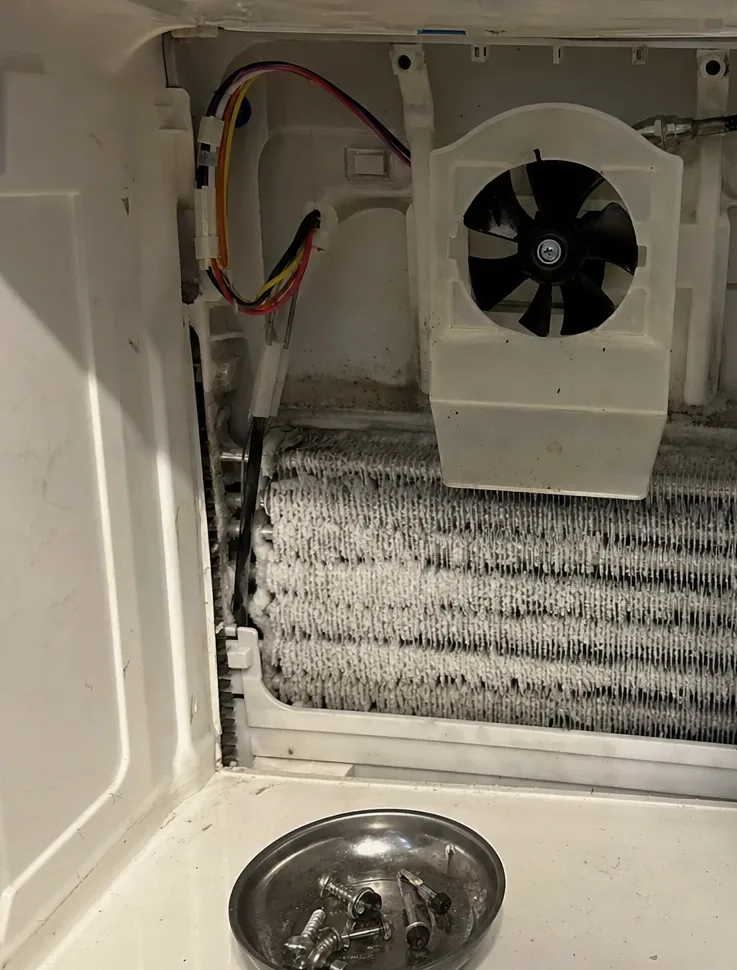
Symptoms we hear most
- Fresh-food side drifting warm while the freezer still holds temperature
- A frost sheet building on the back wall of the freezer compartment
- The unit runs constantly and the cabinet never quite comes down
- Water pooling under the crisper or freezing in a flat sheet on the floor
- Door that no longer pulls itself shut over the last inch of travel
- A hum or rattle from the grille area that rises and falls with the fan
- Not cooling although the unit is plainly running and the lights are on
A built-in Sub-Zero is designed to sit in cabinetry for two decades, which is exactly why the failures that reach us are rarely dramatic. The cabinet drifts two or three degrees warm over a month, the compressor runs longer each week, and nobody notices until the produce goes soft. By then the underlying fault — a restricted condenser, a fan losing speed, a defrost cycle that is no longer clearing the coil — has been running for a while.
What we look at first
Dual-compressor units make diagnosis straightforward, because a fault on the fresh-food side usually stays on the fresh-food side. If one compartment is holding and the other is not, the sealed system is often fine and the problem is air: a blocked evaporator, a fan that stalls when it warms up, or a defrost cycle that ends before the coil is clear. If both compartments drift together, attention moves to the condenser and to airflow through the grille.
On the coast that grille matters more than it does inland. Condenser fins here collect salt as well as dust, and salt holds moisture against aluminium. A condenser that would still be clean after five years in Gainesville can be half-blinded in Ponte Vedra Beach in two, and the compressor pays for it in run time long before anything trips.
The order faults get eliminated in
A warm cabinet has a short list of causes, and the sealed system sits at the bottom of that list rather than the top. Ahead of it are a restricted or corroded condenser, a condenser fan that has slowed or stalls once it is warm, an evaporator fan that has failed, a defrost cycle that ends before the coil is clear, a blocked defrost drain that has iced the trough, and door seals that are admitting humid kitchen air. Every one of those is cheaper, and several of them are more likely here than anywhere inland.
The drain is worth naming separately, because in a house near the water it is a frequent cause and rarely the one people suspect. Melt water from each defrost cycle has to leave the cabinet. When the drain blocks, the trough refills and refreezes as a flat sheet, that sheet blocks the air path, and you arrive at a warm compartment by a route that has nothing to do with refrigerant. Water pooling under a crisper is that fault announcing itself early.
Doors, panels and the last half inch
Built-ins carry custom door panels that weigh more than the nominal panel the hinge was set for. Over several years the hinge takes a set, the door stops pulling itself closed over the final half inch, and the gasket touches on three sides instead of four. In a Ponte Vedra kitchen with the doors open to a pool deck, that gap is a continuous supply of warm, humid air — which loads the evaporator, drives heavier frosting, and looks from the outside exactly like a cooling fault.
Hinge tension, panel alignment and closure travel are all adjustable. It is the cheapest item on the list and worth ruling out early rather than late.
What a visit looks like
We start with readings — compartment temperatures, evaporator and condenser behaviour, defrost activity — and write them down. The diagnostic is a flat fee, credited toward the repair if you approve the work, and you get a written estimate before a panel comes off. Sealed-system work is carried out by EPA Section 608 certified technicians, because recovering and recharging the refrigerant in these units is regulated work and should be treated that way.
Parts are genuine OEM, ordered against the model and serial plate inside your own cabinet rather than a generic cross-reference. Fan motors, defrost components, gaskets and control boards are all specific to the series and the production run, and the wrong-but-similar part is how a repair comes back.
When a repair stops making sense
Sometimes it does. A twenty-five-year-old unit with a failed compressor and a corroded condenser is a conversation, not an invoice, and we would rather have that conversation before ordering parts than after. What we will not do is open a sealed system on a unit we do not expect to survive it.
What the visit includes
- Flat diagnostic with the readings written down, not recited from memory
- Written estimate before any panel comes off or any refrigerant is touched
- Genuine OEM parts, ordered against your unit's own model and serial plate
- 90 days on labour, 365 days on parts
From the journal
- Where to buy a Sub-Zero refrigerator, and what to check before you pay
Buy a new Sub-Zero fridge through a dealer listed on the brand's website. A used one, or one sold with a house, needs its serial tag and condition checked.
- Sub-Zero refrigerator reset button: what to press and what it tells you
A Sub-Zero refrigerator has no separate reset button: you reset it by turning it off at the panel or breaker, then on. What to check when that fails.
- Shutting a Sub-Zero down before a Ponte Vedra summer
What to do with refrigeration in a Ponte Vedra Beach house that will sit empty for months, and why the ice maker is the decision that matters most.
- A Sub-Zero fresh-food side warm, freezer still cold
One side warm and the other cold is a specific diagnostic clue. Here is the order faults should be eliminated in before anyone opens a sealed system.
- Why a Sub-Zero ice maker fails in stages, not at once
An ice maker rarely stops. It degrades in a fixed order, and each stage has its own symptom — here is that order and which parts of it are recoverable.
- Salt air, condenser coils and long run times
Why a Sub-Zero within a mile of the Atlantic runs longer every year, how to read the symptom correctly, and what corrosion on the fins actually means.
What it costs
What does a Sub-Zero built-in refrigerator repair cost in Ponte Vedra Beach?
Most of this work lands between $240 and $2,340, parts and labour together, and the visit that decides which end of that you are at is a flat $80 credited to the repair once you approve it. The firm number is written down after the diagnosis, not guessed at over the phone.
| Work | Typical range |
|---|---|
| Diagnostic visit | $80 flat, credited to the repair |
| Compressor or sealed-system repair | $860–$2,340 parts and labour |
| Door gasket or seal replacement | $240–$650 parts and labour |
| Evaporator or condenser fan motor | $250–$580 parts and labour |
| Defrost heater, thermostat or sensor | $250–$640 parts and labour |
Written estimate before anything is opened up. The invoice carries one number; a band is what can honestly be published before the cabinet is open. The full table is on the pricing page.
Customer reviews
After a sub-zero built-in refrigerator repair visit
4.8 out of 5 from 67 customer reviews. Each one below is a single visit, described by the person who paid for it.
The door alarm kept sounding with the door shut. It turned out to be a magnetic reed switch in the hinge column. The part sat on back order for a week, which was frustrating, but the fix itself was quick.
Colin W.2026-06-11
Our built in held the freezer at zero but the produce was freezing too. A damper flap had cracked and was stuck open. He replaced the damper assembly and let the cabinet settle before rechecking both sides.
Nadia F.2026-04-24
The crisper drawers had frozen everything in them while the top shelves read normally. He found a temperature sensor hanging loose behind the liner, refitted and recalibrated it, and both compartments settled inside a day.
Callum P.2026-09-16
Questions we get asked
Answers before you call
- What does a Sub-Zero built-in refrigerator repair cost in Ponte Vedra Beach?
- Most of this work falls between $240 and $2,340, parts and labour together: compressor or sealed-system repair runs $860–$2,340, door gasket or seal replacement runs $240–$650, evaporator or condenser fan motor runs $250–$580 and defrost heater, thermostat or sensor runs $250–$640. Which band your cabinet is in is what the diagnostic settles, and the figure on the written estimate is the one you are asked to approve.
- Is the $80 diagnostic charged on top of the repair?
- No. The $80 covers the visit and the whole diagnostic sequence, and it comes off the repair the moment you approve the work. Decide against it and the diagnostic is all you have spent: the written findings are yours to take anywhere you like. 90 days on labour, 365 days on parts, and genuine OEM parts on every repair.
- Why does the fresh-food side go warm while the freezer stays cold?
- Because one evaporator feeds both compartments on most built-ins, and the air reaching the fresh-food side travels past a defrost circuit and a fan to get there. Frost across that path, or a stalled fan behind it, starves the warm side first while the freezer carries on holding.
- Why is my Sub-Zero not cooling even though it is running?
- Because running and cooling are two different things. A condenser blinded by salt film, an evaporator fan that has stalled, a defrost cycle that stops before the coil is clear and a compressor that turns without pumping all leave a cabinet humming and warm. They sit at opposite ends of the price table, which is why the readings are taken before anything is quoted.
- How many visits does a built-in repair normally take?
- One, when the part is already on the van. Anything ordered against your own serial plate means a second visit to fit it, and that visit belongs to the quoted repair rather than to a second diagnostic. You are told which of the two you are looking at before you approve anything.
- Is a condenser that looks clean actually clean?
- Not on this coast. Salt film binds dust into a mat that sits between the fins rather than on the face of them, so a pack can look presentable from the front and still be half blinded. Compressor draw is measured after cleaning, because that reading is what says whether it worked.