Service
Sub-Zero undercounter and drawer repair
Service for undercounter refrigerators, refrigerator drawers and beverage centres — the units built into islands and pantries where ventilation is tightest.
Symptoms we hear most
- Drawers that feel cool rather than cold by late afternoon
- Condensation collecting along the inside face of a drawer front
- A drawer that no longer glides fully closed on its runners
- The cabinet running almost continuously in a warm island
- Water sitting in the base of the lower drawer instead of draining
- A beverage centre that pulls down overnight but loses ground all day
Undercounter refrigeration is the part of the kitchen that gets designed last and used most. A pair of refrigerator drawers in the island, a beverage centre in the butler’s pantry, a second freezer drawer near the range — each one is a small sealed system doing the same job as a full cabinet, in about a fifth of the space, usually surrounded on three sides by cabinetry that was drawn before anyone thought about where the heat would go.
Most of the calls we take on these units are not really refrigeration faults. They are installation constraints that have finally caught up with the machine.
Ventilation is the whole story
A full-height built-in has a grille the width of the cabinet and a clear path out of the front. An undercounter unit has a narrow strip along the toe kick, and everything depends on that strip staying open and on the air in front of it being cooler than the air behind. In a Ponte Vedra island with a cooktop on one side and a run of south-facing glass on the other, the ambient sitting in front of that grille in August is not the ambient the unit was rated for.
The failure pattern is distinctive. The cabinet pulls down fine overnight, holds through the morning, and then loses a few degrees every afternoon as the room warms and never quite catches back up. Owners describe it as “cool but not cold”, which is exactly right, and it is the single most common thing we are called out for on drawer units.
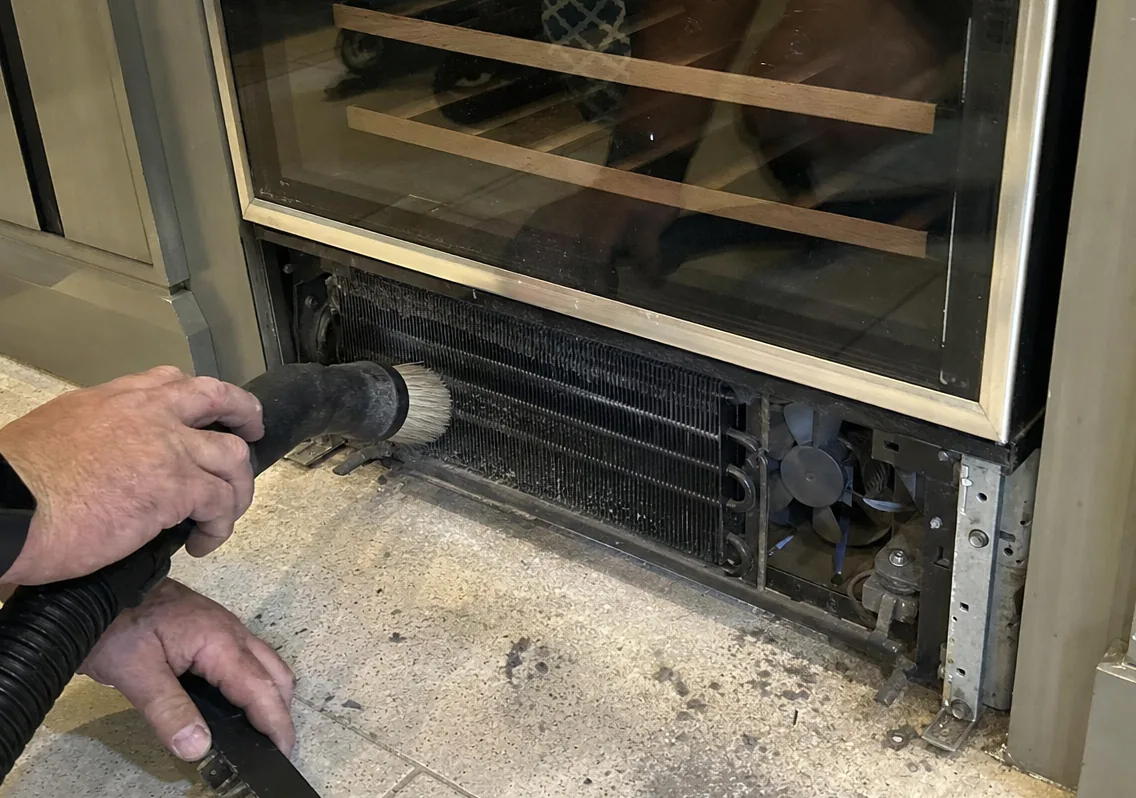
Sometimes the fix is genuinely a repair — a condenser fan losing speed, a fin pack packed with salt and dust. Often it is the grille itself: a toe-kick panel fitted flush by a cabinet maker who did not realise it was an air intake, or a run of new flooring laid up to it. That is worth finding before anyone quotes you a compressor.
Drawers behave differently from doors
A door seals against a flat face with a magnetic gasket and stays shut by itself. A drawer seals on all four sides while riding on runners that carry the weight of the contents, and it only seals properly if it closes fully. Load the lower drawer with bottled water, run it for a couple of years in a busy kitchen, and the runners develop enough drag that the last inch of travel depends on how firmly someone pushed.
The consequence is not a dramatic failure. It is a slow, humid leak of room air into a cold box: condensation on the inside of the drawer front, frost around the opening, water in the base of the lower drawer, and a compressor that runs far more than it should. Runners, gaskets and closure adjustment are all serviceable, and they are worth checking before the diagnosis moves inward.
Drainage in a humid house
These units produce condensate like any other, and in a coastal kitchen with the doors open to the pool deck they produce more of it than the same unit would in a sealed house in Atlanta. The drain path is short, shallow and easy to block with the sort of debris a drinks drawer generates. Standing water in the base is a drain problem far more often than it is a seal problem, and it is cheap to resolve if it is caught before it freezes and pushes on something.
What a visit includes
We look at the install before we look at the appliance: intake clearance, ambient in front of the grille, what has been built or laid since the unit went in. Then readings, then a written estimate before anything is opened. The diagnostic is a flat fee and is credited toward the repair when you approve the work.
Sealed-system repairs are carried out by EPA Section 608 certified technicians. Parts are genuine OEM, ordered against your own serial plate, because undercounter platforms change more often than full-height ones and the visually identical part from two years earlier will not always fit.
What the visit includes
- Ventilation check at the actual install, not the specification sheet
- Drawer runner, gasket and closure inspection with the unit under load
- Written estimate before any panel is removed or refrigerant is touched
- Genuine OEM parts ordered against your own model and serial plate
- 90 days on labour, 365 days on parts
From the journal
- Sub-Zero outdoor refrigeration on an exposed pool deck
Why an uncovered outdoor unit in Ponte Vedra Beach ages several times faster than the same appliance indoors, and which of that damage is preventable.
What it costs
What does a Sub-Zero undercounter refrigerator repair cost in Ponte Vedra Beach?
Most of this work lands between $240 and $2,340, parts and labour together, and the visit that decides which end of that you are at is a flat $80 credited to the repair once you approve it. The firm number is written down after the diagnosis, not guessed at over the phone.
| Work | Typical range |
|---|---|
| Diagnostic visit | $80 flat, credited to the repair |
| Evaporator or condenser fan motor | $250–$580 parts and labour |
| Compressor or sealed-system repair | $860–$2,340 parts and labour |
| Door gasket or seal replacement | $240–$650 parts and labour |
| Defrost heater, thermostat or sensor | $250–$640 parts and labour |
Written estimate before anything is opened up. The invoice carries one number; a band is what can honestly be published before the cabinet is open. The full table is on the pricing page.
Customer reviews
After a sub-zero undercounter and drawer repair visit
4.8 out of 5 from 67 customer reviews. Each one below is a single visit, described by the person who paid for it.
The drawer unit is cold again and the runners no longer catch on the way in. It took longer than I expected to get a date in the book, and nobody rang to say the first part had been sent through wrong.
Soren N.2026-03-19
The unit tripped the breaker every time it tried to start. He found a start relay that had failed short and replaced it along with the overload, then watched several start cycles through before he left.
Wyatt J.2025-03-13
Our drawer unit was sweating along the top edge and smelled musty inside. He found a gasket squashed out of shape at one corner, replaced it, and checked the drawer was closing square before he left.
Dagmar R.2026-05-29
Questions we get asked
Answers before you call
- What does a Sub-Zero undercounter refrigerator repair cost in Ponte Vedra Beach?
- Most of this work falls between $240 and $2,340, parts and labour together: evaporator or condenser fan motor runs $250–$580, compressor or sealed-system repair runs $860–$2,340, door gasket or seal replacement runs $240–$650 and defrost heater, thermostat or sensor runs $250–$640. Which band your cabinet is in is what the diagnostic settles, and the figure on the written estimate is the one you are asked to approve.
- Is the $80 diagnostic charged on top of the repair?
- No. The $80 covers the visit and the whole diagnostic sequence, and it comes off the repair the moment you approve the work. Decide against it and the diagnostic is all you have spent: the written findings are yours to take anywhere you like. 90 days on labour, 365 days on parts, and genuine OEM parts on every repair.
- Why does a drawer unit struggle in an island when the same unit is fine elsewhere?
- Ventilation. An undercounter cabinet draws air in and pushes heat out through a grille that an island often narrows to a slot. The specification sheet assumed a clearance the finished joinery did not leave, and the compressor pays the difference in run time until something is opened up.
- Is condensation inside a drawer front a seal problem?
- Not always. A drawer that no longer closes fully on its runners leaves the same gap a tired gasket does, and humid coastal air finds either one. Runners, closure and gasket are checked together with the unit under load, because separately each of the three looks innocent.